
One of my favorite things about rosaries is how much symbolism and magical power you can shove into one simple, unassuming object. While by no means a traditional Solomonic tool nor one that appears with any regularity in early modern grimoires one of my most used tools in goetic evocation is a bloodstone rosary dedicated to my patron St. Martha the Dragonslayer, also called Dominadora and Our Lady Mary, Empress of Hell¹. With thoughtful selection of materia, precise timing, and careful construction a string of beads can become as potent a weapon as any sword.
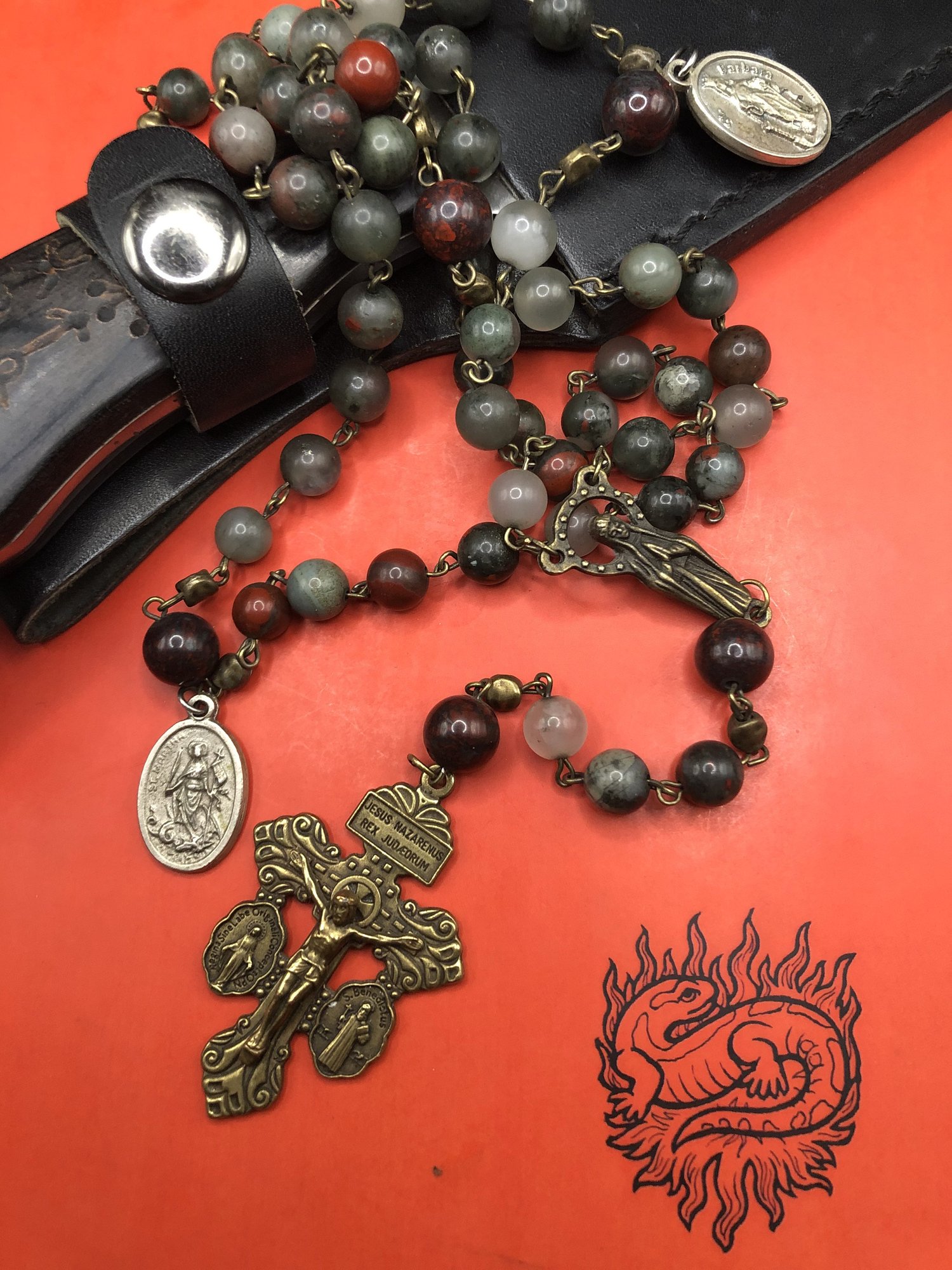
Medieval legend has it that during the crucifixion the blood of Christ turned to stone upon being spilled onto the green earth forming bloodstone and imbuing it with significant magickal power. Here we see a metaphysical link between bloodstone and St. Martha, myrrh bearer, friend of Christ, and witness to the crucifixion and resurrections. Like the bloodstone the colors most commonly associated with St. Martha are green, red, and white providing a pleasant aesthetic link between the rosary’s form and function.
A number of goetic grimoires hint at bloodstone’s effectiveness in wrangling the legions of Hell by its use in the creation of protective devices and phylacteries. The Grand Grimoire in particular uses bloodstone extensively from the creation of a protective amulet called Ematille to inscribing the triangle of evocation and names of Christ on the ground. Most notably it describes using a bloodstone in tandem with a blasting rod to command demons while the karcist works outside the protective circle. Grimoire Verum notes that a protective amulet of authority known as the First Character should be engraved in heliotrope (bloodstone), “which is a stone having great sympathy with the spirits of the Sun, especially those who are wiser and better than others.”
To reinforce these properties of bloodstone, medals to my patrons St. Martha and St. Barbara were affixed to the rosary along with my First Character, and a Pardon Crucifix². Among it’s many details the Pardon Crucifix features a St. Benedict medal (patron saint of exorcists) and a Miraculous Medal depicting Mary’s dominion over infernal spirits:
Mary is standing upon a globe, crushing the head of a serpent beneath her foot. She stands upon the globe, as the Queen of Heaven and Earth. Her feet crush the serpent to proclaim Satan and all his followers are helpless before her.
The twelve stars can refer to the Apostles, who represent the entire Church as it surrounds Mary. They also recall the vision of Saint John, writer of the Book of Revelation (12:1), in which “a great sign appeared in heaven, a woman clothed with the sun, and the moon under her feet, and on her head a crown of 12 stars.”
The chain was ritually hand crafted under auspicious signs and feast days, prayers bent into every link, each anointed with holy oils and fumigated with blessed incenses until a tool that thrums with the power of my spirits was born. In practice I have found it largely replaces the wand as a tool to raise and command power with the added benefit of being considerably more discreet. However I must confess I was never partial to wands to begin with – I have a rosary and a knife, what more could a girl need?
1 – For more information on the Virgin Mary in her emanation of Empress of Hell, please see this post by Rev. Yuri McGlinchey
2- For information on the pardon crucifix and it’s use in necromancy and other magickal rites, please see this post by The Gentleman Necromancer
For a more thorough exploration of the practice of goetic evocation via rosary, please read Ars Rosaria: The Rosary Art of Conjuration by Simon Dyda.
 Via Combusta
Leave a comment